
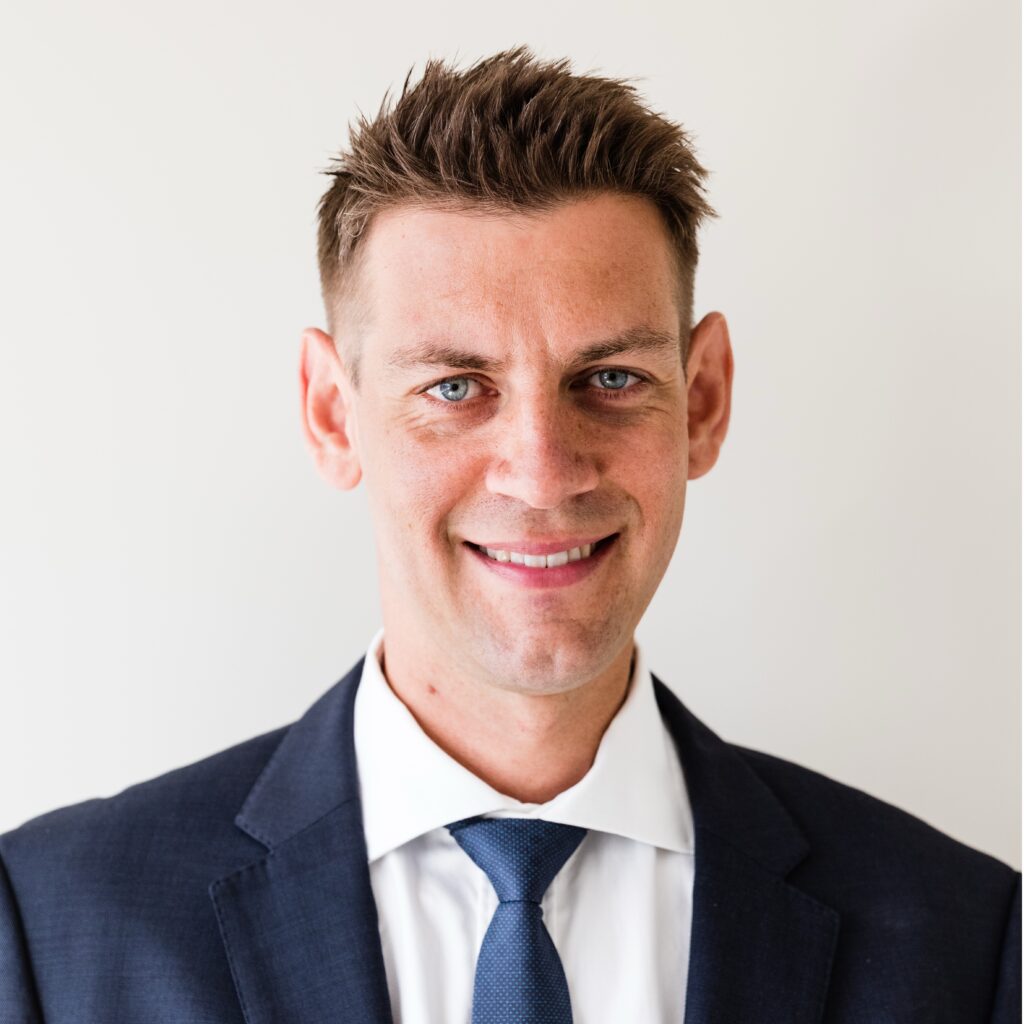
In the field of knee replacement surgery, Dr Keeley has trained in advanced technologies including robotic assisted surgery, computer navigation, patient-specific instrumentation (PSI), and most recently, caliper-verified measured resection technique using kinematic alignment principles. Having utilised all these techniques, he favours the latter approach, which focuses on preserving each patient’s natural joint line, natural mechanical axis (lower limb alignment), and therefore movement pattern. The use of precision cutting guides and calipers to verify bone resections enhances surgical accuracy and may lead to improved joint function, better range of motion, and greater patient satisfaction compared to traditional mechanical alignment techniques.
Dr Keeley is proficient in both posterior and anterior approaches to hip replacement surgery. Having mastered both, he prefers the anterior approach for most patients. This technique allows access to the hip joint without cutting through any muscles or tendons and leads to a reduction in post-operative pain and dislocation risk, and a faster return to mobility and activities of daily living.
Dr Keeley also manages a wide range of knee injuries in younger and athletic patients, offering ligament reconstruction (including ACL and patellofemoral stabilisation), meniscus and cartilage repair, and other minimally invasive arthroscopic procedures. These techniques help patients return to sport or activity with minimal downtime and excellent functional outcomes.
In addition to his orthopaedic training on the AOA NSW orthopaedic training program, Dr Keeley trained in lower-limb trauma surgery at two high-volume public hospitals in Brisbane, equipping him with experience in the surgical management of complex fractures and injuries.
Over the past 15 years, he has gained extensive experience in the management of extremely challenging lower limb cases, including severe high energy fractures of the pelvis/acetabulum and femur/tibia, and also performing highly complex primary and revision hip and knee replacement surgery.
Known for his down-to-earth manner, clear communication, and patient-centred approach, Dr Keeley works collaboratively with physiotherapists and general practitioners to ensure the best possible long-term outcomes for his patients.
I was exposed to hospitals / medicine as a school aged child, because of a sibling’s medical needs. I recall at the age of 12, attending with her and my parents the Women’s and Children’s Hospital in Adelaide for a series of reviews and consultations regarding potential treatment. I remember that I loved the hospital environment, and being fascinated by a meeting of multiple specialists involved in her care. That really formed the basis of my desire to be a surgeon, as a way of helping people in need.
My choice of orthopaedics in particular came later when I was an intern, as I found myself drawn to its mechanical and biomechanical nature. Having a father with an engineering background, and a grandfather who was a cabinet maker, I was perhaps inherently drawn to fields that involved fixing or building things.
I am lucky in the sense that I now only do operations that I really enjoy doing. I love restoring function by giving patients back their mobility, so my favourite operations are therefore lower limb operations, particularly hip and knee replacements, but also keyhole surgery for meniscal tears and sports knee operations (ACL, patellofemoral reconstructions).
I remember a 98 year old lady who still lived at home alone and still did everything herself, including mowing her lawn. She had fallen and broken her hip, and needed a hip replacement to get her back up walking and home again.
I recall speaking to her before her operation, and she said she had never been in hospital before. I said hopefully we will get you back home very soon, and she replied “I hope so, I’ve got a lot of living to do”. She was a perfect example that age is not as important as function and motivation.